
Password Reset Token Misconfiguration Leading to Pre-Account Takeover and Account Deletion 👾


The Story (You Should Think Out of The Box !)
This one didn't start with a shiny exploit or instant success. It started with weeks of hunting, caffeine, and a streak of bad luck.
I had been testing this target for a while and submitted around six reports. Every single one came back as either:
- Duplicate
- Not accepted
- Or the classic “working as intended”
At that point, most people would move on, But I decided to dive deeper.
Instead of chasing edge cases, I marked what I consider foundational identity pressure points — areas that must be right, or everything above them eventually breaks.
Three Things I found on the target while testing:
- Password reset tokens that don't expire (and can be reused).
- No email verification required during signup.
- Change email to any email (that doesn't has account) without verification.
Those Three together felt like a dangerous friendship. So I built a simple scenario.
The Attack Scenario
- Attacker creates an account with victim email → no email verfication required.
- Attacker requests a password reset.
- Attacker doens't open the reset link .
- Attacker changes the account email.
- Attacker reuses the old reset link.
The system allows:
- Password reset
- Authenticated access
- Account deletion
No victim interaction.
Just patience and a very loyal token.

Summary
During assessment, I identified a Pre-Account Takeover (Pre-ATO) logic flaw in the password reset lifecycle.
The system allows a reset token to:
- Remain valid after an email address change
- Be reused long after issuance
- Grant authenticated access without re-validating email ownership
In short: The platform trusts historical identity state more than current ownership.
That's a risky bet.
• • •
Impact
This flaw undermines the integrity of the identity system by enabling:
- Unauthorized password resets (Pre-ATO)
- Access without current email ownership
- Destructive actions like account deletion
Even without targeting existing users, this breaks identity guarantees — and those are hard to explain after an incident.
• • •
Business Risk
From a platform perspective, this introduces:
- Identity confusion and support escalations
- Reduced trust in recovery mechanisms
- Increased regulatory scrutiny around authentication controls
- Long-term exposure as the system evolves
Convenience without expiration is not user-friendly. It's future incident fuel.
• • •
Recommendations
To close this class of issues:
- Invalidate all reset tokens on email change
- Enforce strict expiration on reset links
- Re-validate email ownership at password update
- Prevent reset tokens from granting session-level access
- Add telemetry for stale token usage
These controls don't just fix this bug — they prevent the next five.
• • •
Final Thoughts
This finding didn't come from a fancy payload. It came from listening to the system over time.
Sometimes the bug isn't loud. It waits. Just like the reset link.
And when security controls don't know when to stop trusting the past, the future eventually takes advantage of that.
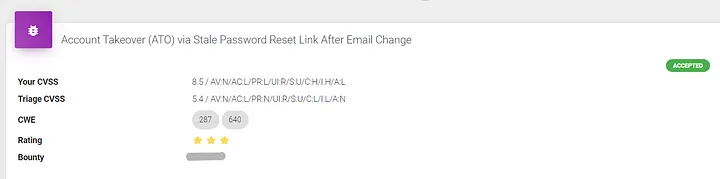
Bug Accepted :)
To add your blog, send an email to hello@bugbountydirectory.com


